Blog
How Should Your Virtual Care Company Bill FFS Insurance?
A two-phase readiness framework for cash-pay virtual care founders deciding when to move to FFS insurance. Includes checklists, timing signals, and pitfalls.
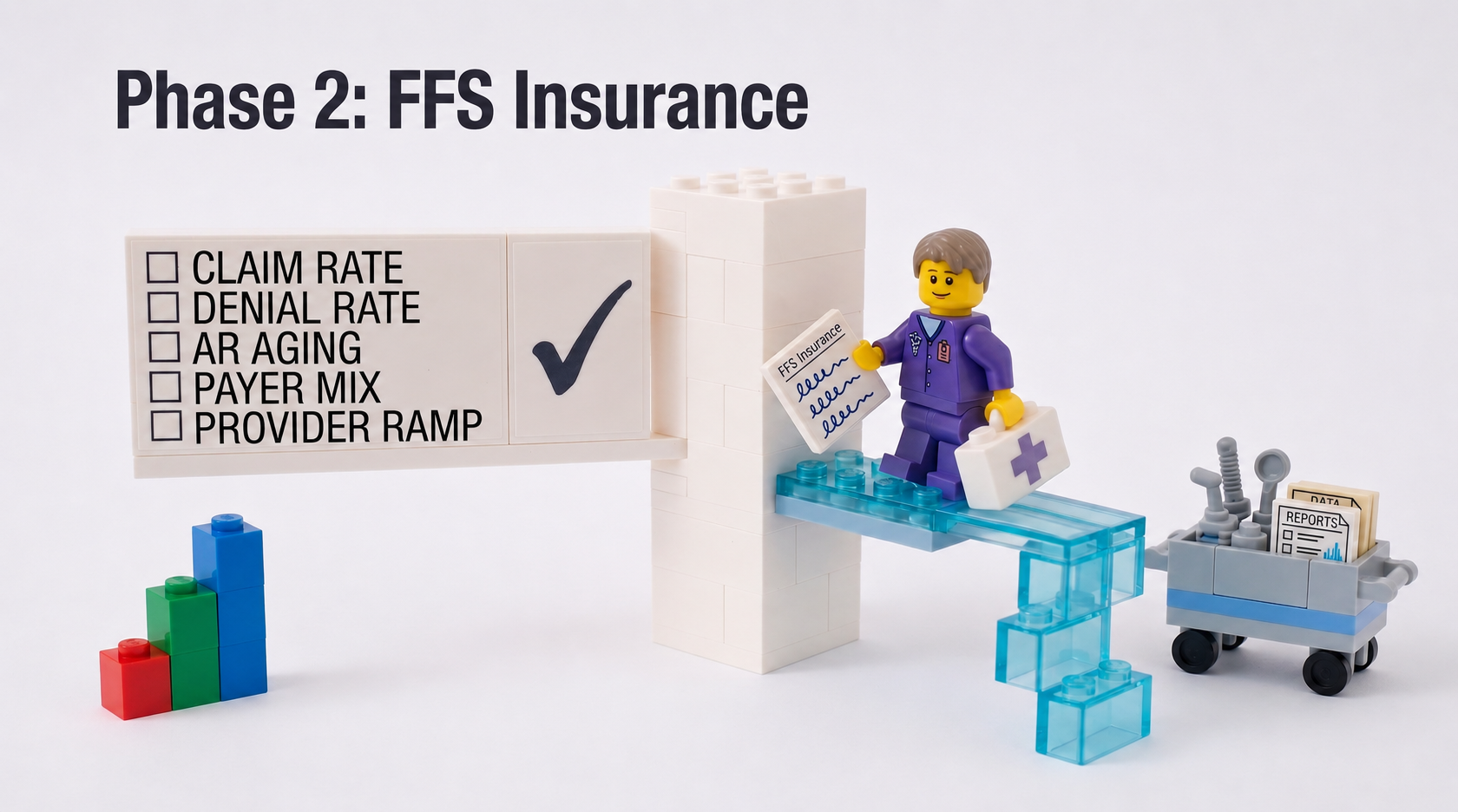

Executive Summary
- Part 2 of Bridge's 4-part operator checklist series by Alex Radke, giving cash-pay virtual care founders a Phase 2 readiness framework for moving to FFS insurance, the channel that unlocks the bulk of virtual care's $250B TAM and produces 2-5x conversion lift plus ~30% retention gains when done right.
- Billing FFS insurance is an operational reset, not a billing change. Founders need clean answers to three questions before activating: does your care model map to existing CPT codes, can your ops absorb multi-payer logistics (5 workstreams, 10+ roles in-house), and do your unit economics hold when revenue per visit drops from cash-pay ($250) to reimbursement (~$95). The day claims start flowing, you also become a HIPAA-covered entity.
Intro
Most virtual care companies make the same mistake when they move from cash-pay to billing insurance. They treat Phase 2 as another revenue line, plug it into Phase 1 operations, and a few months later, both channels are struggling.
This is the second piece in our operator checklist series on the phases of telehealth growth. The first covered cash-pay validation: proven demand, consistent clinical delivery, integrated tech stack. Phase 1 proved your model works. Phase 2 tests whether it scales without breaking.
Phase 2 means billing fee-for-service insurance, where most of virtual care TAM lives ($250B per McKinsey), and where most companies stall. FFS is one of several reimbursement models you'll hit as you scale. PEPM, PMPM, bundled payments, and value-based contracts all enter the conversation eventually, but they layer on top of FFS infrastructure rather than replace it.
The operational work of billing insurance is the same whether you build it or partner. The critical question to consider is: are you building an insurance company or a virtual care company that bills insurance? That answer decides the next two years, either assembling a billing org or delivering excellent care.
The checklist below covers the operational side. Your ops lead can use it to map your care model to CPT codes, model volume and economics, and stress-test capacity against the reimbursement math. The strategic call is yours. If you want to compare benchmarks, timelines, or how other founders worked through it, we're happy to share what we've seen.
Why the FFS transition is harder than it looks
Moving to FFS unlocks the part of the TAM your cash-pay model can't reach. Cash-pay companies that make the move see conversion lift in the 2-5x range and retention gains around 30%.
The math reshapes fast. A cash-pay virtual care company doing 500 visits/month at $250 per visit clears $1.5M in annual revenue. Add insurance at a conservative 2x conversion lift and an average reimbursement of $95 per visit, and total volume moves to roughly 1,000 visits/month, with annual revenue landing near $2.7M from cash-pay-equivalent and insured visits combined. At a 4x lift, the same business is modeling $5M+.
The cash-pay-to-insurance move sounds like an isolated billing change. It isn't. It fundamentally changes how patients find you, how they convert, how providers document, and how revenue arrives. The 2-5x and 30% numbers belong to companies that completed the operational reset. The ones that bolted billing onto cash-pay workflows don't see them.
Your old funnel, your old EHR fields, your old clinical workflow, your old reporting, most of it needs revisiting once a third party is paying the bill. The economics become challenged when adding a credentialing team, an RCM team, and a compliance program to your P&L.
Phase 1: Cash-Pay Validation (Recap)
Full version in When Should Your Virtual Care Company Accept Insurance?
- Demand generation produces patients at a CAC your business can sustain
- Clinical delivery is consistent across providers and predictable in volume
- Your tech stack integrates intake, scheduling, EHR, payments, and reporting end-to-end
- You can articulate the unit economics of a typical patient visit in your sleep
Hitting these markers earns you the option to move. Saturation signals tell you when to take it: CAC climbing, conversion drop-off at the price question, patients asking if you take their insurance.
Phase 2: FFS Insurance Activation
Phase 2 is where your TAM expands from a small slice of patients who can afford cash-pay to the insured population. The goal is to bill insurance at scale across multiple health plans without compromising the quality of care or the unit economics that got you here.
Before you build anything new, three questions need clean answers:
- Does your care model align well enough with established CPT codes to operate at scale?You don't have years to wait for a new code. Companies that try to create new codes are playing a long game: Omada didn't get CPT 0488T approved until seven years after founding. For Phase 2, your care model has to map cleanly to codes that exist and are reimbursed today. If your clinical workflow assumes 45 minutes of provider time but your only available code reimburses for 15, you're going to lose money on every visit.
- Can your operations absorb multi-payer logistics without consuming the team?Insurance billing means contracting, credentialing, eligibility verification, coding, claims submission, denials, appeals, AR management, audit, compliance. Done in-house, that's 5 distinct workstreams and 10+ cross-functional roles. Most operators we talk to can build it themselves. The question lies in opportunity cost and whether they want to spend the next few years doing it.
- Are your unit economics sustainable when revenue per visit drops?Cash-pay revenue per visit will almost always exceed insurance reimbursement on the same encounter. With FFS, the economics work because volume and total revenue income increase, but net income only improves when cost-to-serve is built for that volume. A model that assumed a $250 visit and now has to operate on $95 in average reimbursement needs to know the operating costs before going in-network, not after.
If reimbursement, operations, and unit economics are sound, you're ready to activate insurance. If they're not, insurance will magnify your operational gaps.
Day one with insurance: what changes
Assuming you have your payer contracts, once you flip the switch, the operational changes hit every downstream operation. Most teams underestimate this.
Intake. Eligibility verification has to run before scheduling. Demographics and insurance capture have to happen in the booking flow. Copay collection becomes part of the patient experience.
- Why it matters: front-loading eligibility prevents the denials and patient confusion that erode margin downstream, and it lets you market "we take your insurance" as a conversion lever. If you don’t do it in real time at signup, you can significantly hurt provider utilization, as ineligible signups take spots that could be filled by eligible patients.
EHR. Required fields multiply. Patient identifiers, subscriber relationships, place-of-service codes, and modifier logic. Most EHRs designed for cash-pay don't enforce these.
- Why it matters: your EHR stops being a clinical tool and starts being a revenue infrastructure. Missing fields turn into unbillable claims and DSO drag.
Clinical documentation. Coders need time-on-visit, medical decision-making, review of systems, problem list, and assessment-and-plan structured in a way the chart audit will support. Provider documentation that worked for cash-pay won't always survive a health plan audit.
- Why it matters: documentation discipline ensure charts are audit ready, protects revenue from clawbacks and the company from contract termination. The cost of getting it right is small. The cost of getting it wrong is denials, clawbacks, and audit exposure. We've written before about why we audit charts so aggressively; this is where it shows up.
Coding. The gap between what providers document and what billers can submit is wider than most founders expect. The clinical-to-billing handoff is its own workstream, and most operators don't staff it as one.
- Why it matters: this is where revenue quietly leaks. Every documentation-to-billing gap is a missed claim or a denial that nobody on the team sees in real time.
Claims and denials. Claims have to go to a clearinghouse on a defined cadence with proper edits. Denials need a triage SLA. Without one, they fall to whoever happens to have time, and that prioritization stops working past a few hundred claims a month. Generic eligibility checks alone cause 15-20% of denials; your denial discipline has to compensate for the rest.
- Why it matters: every denied claim is direct revenue loss, and every delayed appeal extends DSO. Discipline here is what makes cash flow predictable enough to plan against.
Patient experience. Copays come as a surprise to patients used to your cash-pay flow. EOBs confuse them. Balance billing creates support tickets. Superbills puts the burden on them. Your customer support team becomes, in part, your insurance navigation team.
- Why it matters: the insurance experience can erase the patient experience you spent years optimizing in cash pay. Retention, NPS, and reviews depend on getting this right. Doing this wrong can set you back even farther than when you started with insurance.
Compliance. Most cash-pay virtual care companies aren't HIPAA-covered entities. Billing insurance changes that. The moment you submit electronic claims or run electronic eligibility checks, you're a covered entity under HIPAA, on the hook for the full Privacy Rule, Security Rule, and Breach Notification Rule. That means a Notice of Privacy Practices, Business Associate Agreements with every vendor touching PHI, designated Privacy and Security Officers, workforce training, and a documented risk analysis.
- Why it matters: this is the change with the longest tail. The operational lift is real but doable. The risk of getting it wrong (OCR enforcement, breach exposure, contract termination by health plans that audit BAA chains) quietly compounds until something goes sideways. Most operators don't realize the covered-entity clock starts the day claims start flowing.
Reporting. New metrics show up: clean claim rate, denial rate, DSO, AR aging, payer mix, days-to-payment, first pass adjudication rate, underpayment rate, pended claims rate. None of these were on your dashboard before.
- Why it matters: these become your board-level metrics and ensure you can scale sustainably. You can't run an insurance business without them, and most cash-pay reporting stacks don't track them.
Phase 2 operational achievement checklist
☐ Your care model maps cleanly to established CPT codes and you've validated the mapping with a coder
☐ Eligibility verification runs pre-visit, not post-visit, and pulls real-time benefits
☐ Clinical documentation supports the codes being billed without provider rework
☐ Claims submission has a feedback loop and clean claim rate is tracked weekly
☐ Denials are triaged on a defined SLA with named owners
☐ Patient financial experience is mapped end-to-end: copays, balances, EOBs
☐ Provider economics is measured in encounters and RVUs, not just visits booked
☐ Payer mix is reported monthly and matches your strategic target
☐ AR aging is reviewed monthly and write-off rules are documented
☐ Compliance posture is documented (HIPAA-covered entity status confirmed; Privacy and Security Officers named; workforce trained on HIPAA obligations; fraud-and-abuse awareness; Notice of Privacy Practices drafted and deployed)
☐ Business Associate Agreements signed with every vendor handling PHI (EHR, clearinghouse, billing platform, communications, analytics; between your PC and your MSO, finance, etc.)
How to know Phase 2 is working:
- Clean claim rate stabilizes above 95%
- Denial rate sits at or below 5% steady-state
- AR aging stabilizes (new providers stop creating spikes)
- Your payer mix matches the population you're targeting
- New provider ramp time to producing clean claims has compressed
When these signals are stable, you're ready to think about Phase 3. Whether and when you take that option is what we’ll discuss next in this series.
Common (and costly) mistakes
- Treating insurance activation as a billing change. The most expensive mistake. Insurance billing rewires how care gets delivered: how patients book, how providers document, how revenue arrives, and how the team measures itself. Companies that try to bolt it onto a cash-pay operation watch the operation break.
- Letting provider documentation lag the coding requirements. Clinicians who chart for clinical purposes will not, by default, chart for billing purposes. Every visit documented incorrectly is a visit that either can't be billed, gets denied, or creates clawback risk on audit. And retraining a clinical workforce to chart differently gets harder the longer cash-pay habits set in, which makes the documentation gap the rare problem that gets more expensive to fix every quarter you delay.
- Underbuilding the eligibility step. Discovering after the visit that coverage doesn't apply is how denials and patient frustration compound.
- Skipping the patient financial experience. The first time a cash-pay patient gets an EOB and a balance bill, your support team will hear about it. Design the experience first.
- Not measuring payer mix monthly. Payer mix is a leading indicator of revenue volatility, and it shifts before revenue does. Teams that don't track it monthly find out the change from the P&L.
What's next
Phase 2, done well, is the foundation for Phase 3: scaled demand generation, channel partnerships, and the patient acquisition motion described in the marketing-vs-clinical focus piece. The virtual care companies that stay stuck in operational debt are almost always the ones that treated Phase 2 as a billing change instead of an operational reset.
For most founders, the harder question is build vs. partner. The FFS move itself is increasingly assumed; the more consequential decision is who runs the insurance stack. We've laid out how we think about that decision in Build vs. Partner. Either way, this transition rewards companies that bring a plan, named owners, and dates.
Bridge runs the full insurance stack on a single platform: payer contracting, credentialing, eligibility, RCM, and compliance through one API integration. Partners go in-network nationally in about 30 days, and Bridge assumes the financial risk on claims and denials for eligible patients.
If you're sizing up the build vs. partner decision, book a meeting. We can share benchmarks, timelines, and how this has played out for other founders.
This is part 2 of a 4-part series
Up next: the transition from PMPM-funded models to FFS insurance. Different starting point, same checklist discipline.
- When Should Your Virtual Care Company Accept Insurance?
- How Should Your Virtual Care Company Bill FFS Insurance? (you're here)
- PMPM to FFS Insurance
- Launching Day-One With Insurance (e.g., Medicare-first models)
Follow Bridge on LinkedIn to catch parts 3 & 4 as they publish
You may also like

Build vs. Partner: A Strategic Guide to Scaling Commercial Insurance for Virtual Care
Speed, scale, or control? A decision-making guide for virtual care leaders navigating commercial insurance expansion.

The 2-5x Conversion Lift Hiding in Your Insurance Flow
Most telehealth funnels leak patients because insurance adds friction. When insurance feels as simple as checkout, conversion jumps 2–5×. Here’s where the drop-off happens...and how to fix it.