Blog
The 2-5x Conversion Lift Hiding in Your Insurance Flow
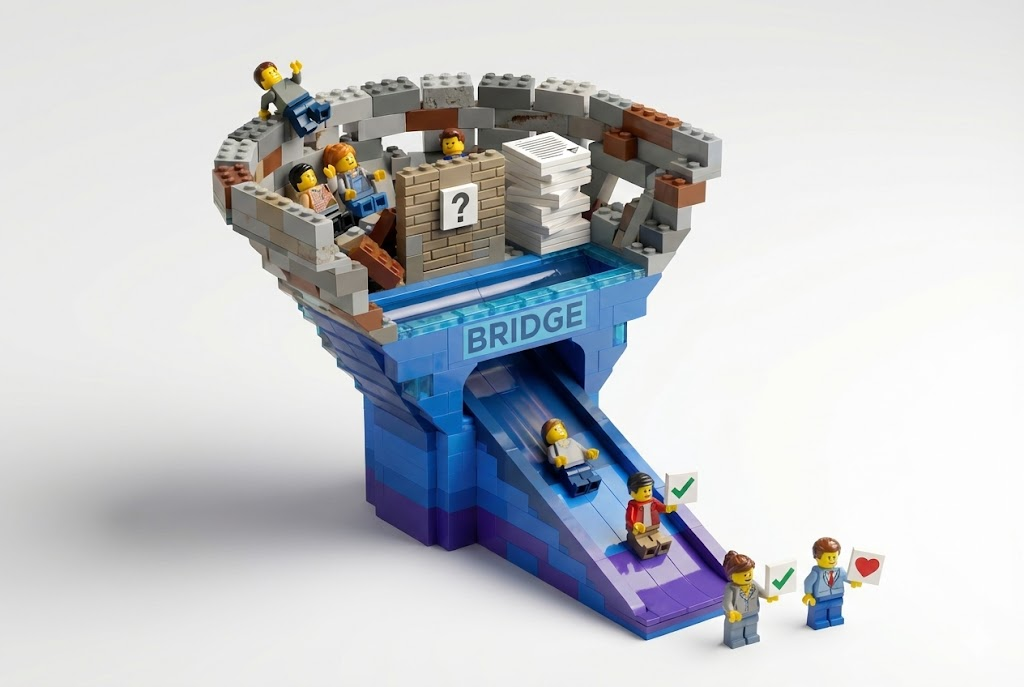
Most telehealth funnels leak patients because insurance adds friction. When insurance feels as simple as checkout, conversion jumps 2–5×. Here’s where the drop-off happens...and how to fix it.
.png)
Executive summary
- Insurance can increase conversion two to five times, but only when the experience feels as simple as a normal checkout. Any extra steps or uncertainty wipes out the benefit.
- Bridge makes this possible by making insurance effectively invisible. Patients get real-time coverage matching, clear out-of-pocket costs, highly accurate eligibility checks, and automatic re-verification instead of the manual workflows that cause drop-off.
- The result is a funnel that finally performs. Patients move forward with confidence instead of abandoning the process, which unlocks the clinical and financial value you already built.
You spent so much time and passion building a world-class clinical experience. You hired the best providers, designed an elegant patient interface, and created a care model that actually works. But most of your target patients never see it.
They abandon your funnel somewhere between "This sounds perfect for me" and clicking the "Pay now" button. The culprit isn't your care model or your clinical team. It's insurance friction that kills conversion before patients ever experience your clinical value.
Accepting insurance increases conversion by 2-5x compared to cash-pay models, but only if the insurance experience is as seamless as normal checkout. Most telehealth companies add insurance to their funnel and watch conversion plummet because they've replaced a simple payment flow with insurance card uploads, manual verification delays, and cost uncertainty.
The companies that actually see that 2-5x improvement? They make insurance invisible. The best patient experience is one where insurance works so seamlessly that patients are delighted with how simple it is.
The reality of your funnel
Your ideal patient is motivated, has insurance, and genuinely needs what you offer. They're excited when they discover your service. They're one click away from booking. They're also one click away from abandoning your funnel entirely.
Most telehealth companies lose these patients not because of clinical concerns, but because of insurance friction at four critical moments in the patient journey. Let's walk through where conversion breaks down and what we built at Bridge to fix it.
Stage 1: Discovery → "Does my insurance cover this?"
Where conversion breaks: A patient clicks "Get Started" and immediately hits a wall. They need to find their insurance card, photograph it, and upload it for verification. Or they manually enter group numbers and member IDs, hoping they typed everything correctly. Then they wait for days or weeks while someone manually verifies coverage. Many companies still use an even more manual approach: patients submit their insurance information through a form, then wait for someone to email them back with verification.
The scale of this problem is staggering. A Kaiser Family Foundation report found that almost 6 in 10 insured adults reported problems using their health insurance in the past year. And among those needing mental health care, three-quarters reported issues.
Each of these approaches kills conversion. Motivated patients abandon here not because they're uninterested, but because the process creates too much friction at exactly the wrong moment.
What Bridge enables: We eliminated the friction entirely. A patient types their insurance plan name into a search field that indexes 6,000 different plan names, matching whatever appears on their card. In many cases, they don't even need to enter their member ID. Our system returns real-time verification within seconds.
No photo uploads, manual data entry, or waiting. The patient sees "Your insurance covers this service" before they've had time to reconsider.
Stage 2: Enrollment → "Wait, how much will this cost me?"
Where conversion breaks: A patient sees "Your insurance covers this!" but has no idea what that means for their wallet. What's their copay? Have they met their deductible? Is there coinsurance? They're being asked to commit without knowing if they can afford it. Financial uncertainty at the moment of commitment kills conversion, even when the actual cost would have been affordable. A 2022 HealthSparq survey found that 44% of respondents avoided healthcare services entirely because they were unsure of the costs and what their insurance would cover.
What Bridge enables: Transparent cost estimates eliminate this uncertainty. Before a patient books, they see their out-of-pocket estimate. Not "your insurance covers this" but "your copay estimate is $35." Bridge verifies coverage and calculates costs using actual contracted rates, not generic coinsurance percentages that leave patients guessing.
Most eligibility systems return vague information like "20% coinsurance" without context about what that percentage applies to. Patients see that and bail because they can't afford surprises. When you show the actual dollar amount, financial anxiety disappears. The patient books with confidence.
Stage 3: Getting Care → "Will this actually process correctly?"
Where conversion breaks: A patient completes their appointment. Everything goes perfectly. Then six weeks later, they get a surprise bill. The insurance claim was denied. "But you said my insurance covered this!" Trust destroyed. Patient lost.
This is the moment that ruins telehealth companies. You delivered excellent care. The patient loved the experience. Then the billing process torched the relationship. The patient blames you, not the insurance system, because from their perspective they did everything right.
What Bridge enables: Our eligibility verification runs at 96% accuracy, and we commit to handling the remaining 4%. The patient gets care knowing that if something goes wrong with claims processing, it's not their problem to fix. Bridge handles it.
This level of confidence transforms the patient experience, but 96% accuracy doesn't happen by accident. We built systems that check not just patient coverage, but provider enrollment status, service-specific authorization requirements, and contract-level billing rules. Most telehealth companies don't build this internally. The expertise required spans insurance operations, provider credentialing, and claims processing. Getting it wrong once destroys patient trust. Getting it right consistently requires what we've spent years building.
The difference is simple: patients focus on their care instead of insurance anxiety.
Stage 4: Staying Connected → "Will my coverage still work?"
Where conversion breaks: Months later, a patient returns for follow-up care. They show up and discover their insurance is no longer active. Their employer changed plans, or their coverage lapsed. "Sorry, your insurance doesn't work anymore." The appointment is wasted. The relationship is damaged.
Patients don't blame their employer's HR department when this happens. They blame the telehealth service that can't keep track of their coverage. Even though the coverage change wasn't your fault, the patient experience failure becomes your problem.
What Bridge enables: We run automated eligibility re-checks 24-72 hours before every appointment to catch coverage changes before they become problems. If something changed, the patient gets flagged immediately with time to update their insurance and re-verify, or choose to pay cash. The problem gets solved before they're sitting in the virtual waiting room.
Most telehealth companies rely on spreadsheets and manual checks. By the time they catch coverage changes, it's too late. The patient is already frustrated, and you're scrambling to fix what should have been prevented.
Confidence is conversion
The pattern across all four stages is consistent: handling complexity behind the scenes creates patient experiences that feel effortless. It's making all the complexity invisible.
Bridge's SDK integrates directly into your existing systems, sitting under your UI and handling all the eligibility logic while enabling you to track analytics seamlessly. Patients interact with your brand, your design, your experience. Bridge just makes insurance work without them having to think about it.
The result is dramatic. Converting 2-5x more patients is about ensuring patients can actually access the clinical experience you already built. Every patient who thinks "I'll verify my insurance later" and never comes back represents revenue you'll never recover. They're interested patients who hit administrative friction at exactly the wrong moment.
That's the difference between a funnel that leaks patients at every stage and one that actually converts. Because you, in partnership with Bridge, made it possible for patients to access your game-changing care model.
Ready to fix your funnel?
If you're seeing patients abandon during enrollment, or if you're hesitant to add insurance because you've seen how complex it gets, we should talk.