Blog
The Math for Building Insurance Operations In-House
A cost model for virtual care CEOs weighing whether to build commercial insurance operations in-house. The five workstreams, headcount, timelines, compliance exposure, and the threshold where building beats partnering.
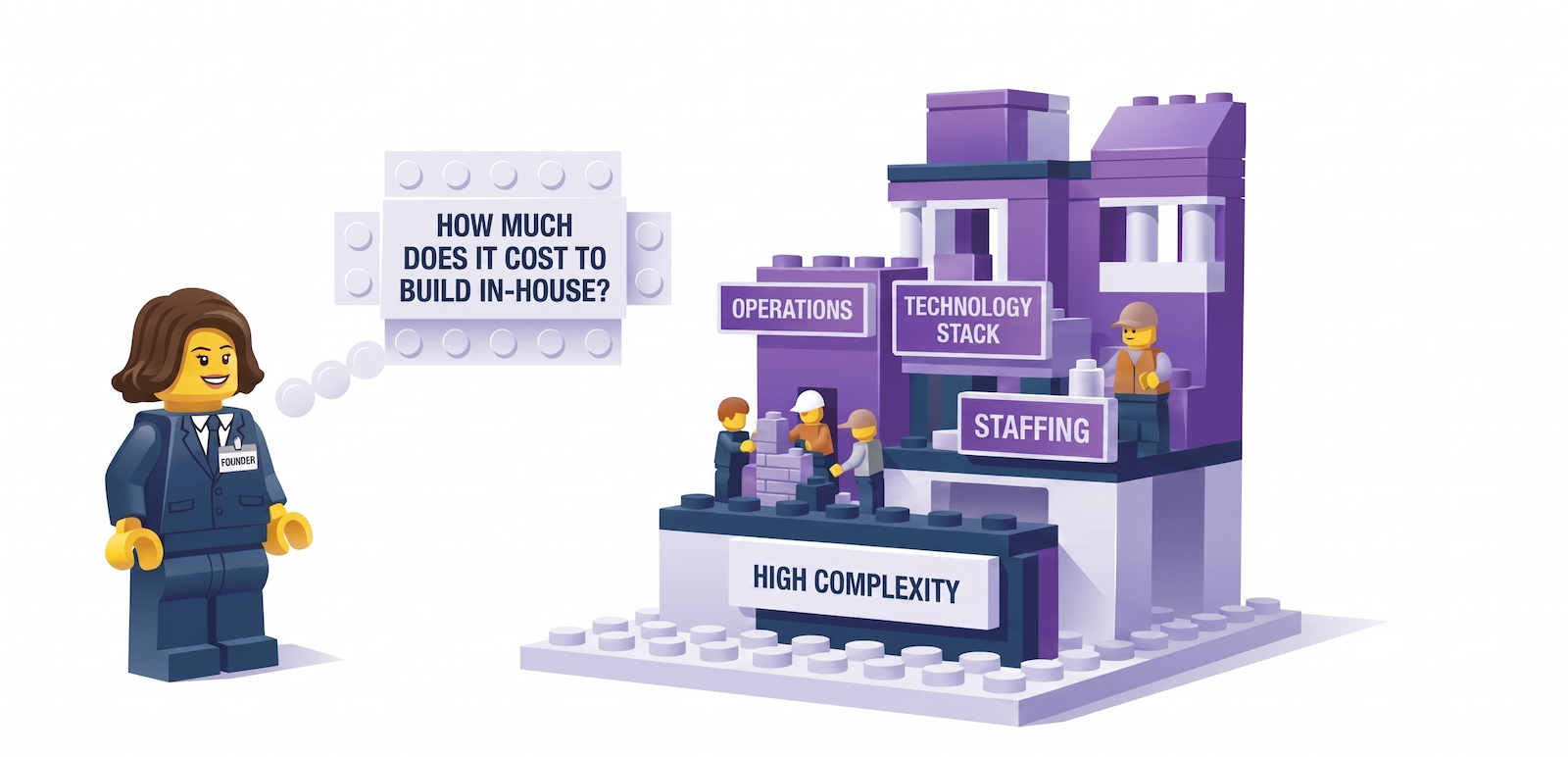

Executive summary
- The cost of building in-house. Nationwide commercial insurance operations cost virtual care companies 20-25% of gross revenue at steady state. That covers five workstreams you can't skip: health plan contracting, provider credentialing and enrollment, eligibility and benefits verification, coding and claims submission, and denials & AR management.
- The timeline and opportunity cost. The DIY path takes 1-3 years to reach nationwide contract density and 90-120 days per provider per health plan per state to credential. Denial rates start at 10% or higher and take 6-12 months to stabilize. Every month a credentialed provider sits unenrolled costs roughly $65,000 per FTE in lost revenue, which makes timeline the biggest hidden cost in most build models.
- When to build vs. partner. The build case holds under a narrow set of conditions: a single-state focus with a small set of health plans, a strategic reason to own the workstream (a proprietary health plan relationship, a custom clinical model, vertical integration with a parent organization), or a strategy where time-to-revenue is not the binding constraint. For virtual care companies that need national coverage quickly, partnering can get you in-network in ~30 days through one platform covering all five workstreams. If you're working through the decision, we're happy to share benchmarks, timelines, and case studies from companies on both sides. Reach out here.
Why founders underestimate the build cost
When virtual care companies decide to scale commercial insurance, the build-versus-buy decision shapes the next 18 months of revenue, runway, and focus. Most of the time, it gets answered on vibes. This piece replaces vibes with numbers.
What's missing from most founder conversations is a line-item cost model for the build side. We see the spreadsheets regularly, and the build cost is consistently underestimated. The gap is usually the difference between a strategic build and an expensive distraction from the core business.
This is a walkthrough for CEOs weighing the build path, covering workstreams, headcount, timelines, compliance exposure, and opportunity cost. It's written for the company seriously considering whether or not to build an in-house operation.
The framing most founders start with
"We'll just hire a couple of people and figure it out."
What's usually behind that statement is some mix of:
- "Our team is smart, they'll learn it."
- "It's just billing, how hard can it be."
- "We don't want to depend on a vendor for something this strategic."
A close cousin: the practice with 1-2 people doing this work in a single state today, assuming national expansion is a copy-paste. The shape of the work changes when the surface area does.
None of those framings is wrong on its own. None of them is a model either. A model is a hard number on both sides of the decision.
The five workstreams you can't skip
Insurance infrastructure consists of five distinct workstreams. You can outsource pieces. You can't skip any.
1. Health plan contracting.
Relationships with health plans, rate negotiation, ongoing rate ladder management, contract compliance. The work is part legal, part business development, part data analysis. Going in-network nationally means hundreds of separate negotiations. Contract density at the national level takes 1-3 years to build internally, and that assumes you've already hired a contracting lead who knows what they're doing. For most states, capturing the bulk of commercial lives means contracting with the top 3-5 health plans. Rates will be rack or below until you have enough scale or outcomes to hold negotiating power.
2. Provider credentialing and enrollment.
90 to 120 days per provider per health plan on average. The workstream is CAQH management, primary source verification, application submission, status tracking, and follow-up. The math compounds: 10 providers across 8 states and 4 health plans equals 320 individual enrollments to manage. As provider and health plan count grow, the surface area grows combinatorially. An inexperienced team that makes enrollment mistakes restarts the whole process.
3. Patient eligibility and benefits verification.
Real-time, ongoing maintenance. Generic eligibility checks cause 15-20% of claim denials, so the work isn't "run an insurance check." It's running the right check, with the right specificity, against a plan directory that changes constantly. Active coverage is the easy part. Looking up the benefit design to see if the service the patient is trying to book is covered is harder. Calculating patient responsibility is a separate challenge again.
4. Coding and claims submission.
CPT mapping, EHR plumbing, clearinghouse setup, claim edits, modifier logic, place-of-service codes, submission cadence. New billing functions should expect challenges getting this off the ground, even with an experienced coding lead. Workflows take time to stabilize, which means denial rework eats up your back office before claims reach your AR team. Volume ramp is the other failure mode. When claim submission can't scale at the pace of visit growth, claims sit in queue, and submission delay translates directly to payment delay. A week of backlog is a week of slipped cash.
5. Denials and AR management.
Triage discipline, submission and appeal timelines, write-off rules, health-plan-specific patterns. A typical learning-curve denial rate is 10% or higher. Steady-state is around 5%. The 6-12 months between those numbers is lost revenue while your team learns.
The headcount picture
To staff this in-house at the volume of an early-stage virtual care company:
- A health plan contracting lead (senior, expensive, or outsourced to a consultant)
- Credentialing and enrollment specialists (roughly 1:50 providers)
- RCM operations staff for coding, billing, denials, AR, and appeals (often a combined role early on, specialized with scale)
- A compliance officer (HIPAA, fraud-and-abuse, OIG-aware, often an exec role early with support from counsel until significant scale)
- Engineering support for benefit verification, clearinghouse, and EHR integrations
Hiring for this is harder than the headcount math suggests. Most RCM, credentialing, and enrollment talent built their experience in a single state with a small set of local health plans. Running the same workstreams across 50 states plus DC is a different job: more health plan relationships, more state-specific rules, more enrollment combinatorics, more eligibility variance. The people who've done it at virtual care scale are scarce, and the ones who can lead it command a premium.
What we see more often at earlier-stage practices is a bare-bones approach: outside counsel on retainer, point solutions without cohesive integrations, operations teams working in silos with poor economies of scale, and consultants filling leadership gaps.
The all-in cost of doing this well is often underestimated, and the build is often underinvested in. This is just headcount. Tooling adds material spend on top: clearinghouses, eligibility platforms, claims management software, and the integrations between them.
We've published the equivalent cost comparison for the partnership side. The point isn't that one path is cheaper. The point is that the build path is rarely 30% cheaper.
The timeline picture
Time is the second-most-overlooked cost for founders.
- 1-3 years to contract density. That's how long a competent internal team takes to negotiate nationwide contracts. It's also how long most new practices take to negotiate rack rates they'll be stuck with until the next renewal cycle.
- 3-4 months per provider per health plan for credentialing. Multi-state expansion compounds fast: 10 providers across 10 states and 10 health plans means up to 1,000 separate enrollments. At 10+ health plans, the full ramp stretches to 6-9 months.
- 6-12 months to a steady-state paid claims rate above 90%. Candid Health benchmarks "good" at 92% and "excellent" at 95% or above. Your team learns by losing money on early claims. That's tuition.
- 3-6 months minimum to operational stability. Even with everything else in place.
The compounding opportunity cost is where this gets expensive. Every month providers sit credentialed but not enrolled is roughly $65,000 per FTE in lost revenue. Multiply by team size and the delay becomes the largest line item in the model.
What's not on this list, but should be: the CEO, COO, and CFO time spent deciding the insurance strategy in the first place, and then selling that strategy to the board, investors, and advisors. That's typically 3-6 months of senior leadership attention, and it's the most expensive labor in the company.
The compliance picture
Insurance billing changes your regulatory footprint.
- You become a Covered Entity under HIPAA, with new obligations around PHI handling, breach notification, business associate agreements, and audit posture.
- OIG fraud-and-abuse exposure kicks in. Anti-Kickback Statute, Stark Law, and False Claims Act considerations apply once you bill federal health programs. The practices these rules flag are worth designing around even if you don't bill federal programs, because state-level versions apply to commercial health plans too.
- State-level billing regulation. 50 different surface areas plus DC, each with its own clinical scope rules, claims regulations, and documentation requirements.
We've written about the four pillars of clinical operations that sit underneath this work: Patient Safety, Care Delivery Standards, Quality Oversight, Technology Governance. Standing those up internally is, by conservative estimates, 6 months of a dedicated hire and $100,000 just to validate against state and federal requirements before you bill your first insured visit.
The unit economics
Bridge's benchmark for scaling in-house insurance operations nationwide is 20-25% of gross revenue. That's the all-in cost of contracting, credentialing, eligibility, coding, claims, denials, and compliance, as a percentage of allowable (what you expect to collect).
Across the models we've reviewed, the line items founders skip most often are health plan contracting talent, audit and compliance costs, and the engineering hours to wire clearinghouse to EHR. Once those three are added back, most internal budgets land closer to the 20-25% benchmark, and most founders realize they were modeling against a number that didn't include the work that costs the most.
That number isn't a fixed cost. It scales with you. And it's the line item that competes most directly with clinical hiring, marketing, product, and everything else that makes your company materially better at delivering care.
What changes for a company already billing insurance vs. one considering it
The math doesn't apply uniformly across the companies that ask us this question.
Companies already billing some insurance (weighing whether to scale in-house) have part of the workstream stood up. The gap is usually contract density and credentialing throughput. Scaling nationally introduces complexity that doesn't exist at smaller scale.
Companies considering insurance for the first time (cash-pay today) start from zero. Every workstream needs to be built simultaneously. The cost is a full investment, not a marginal one. This is the population that most underestimates the build math.
When building in-house makes sense
The case to build holds in a narrow set of conditions:
- You're focused on a single state with a finite, small number of health plans to contract with and manage.
- You have a specific strategic reason: a unique health plan relationship, a proprietary clinical model that requires custom claims handling, or vertical integration with a parent organization.
- You have the leadership talent in-house to run a national billing operation.
- Time-to-revenue is not the binding constraint on your strategy.
Be honest about which case you're in. If most of those conditions are true, you're in the build case. If you're expanding beyond a single state, don't have a unique strategic reason to own the workstream, and time-to-revenue matters, you'll save time, money, and risk via the partner route.
The decision framework
The build vs. partner decision deserves a hard number on each side.
If you're going to build, model the workstream honestly. Five workstreams. Headcount and tooling. 1-3 years to nationwide coverage. 10% of gross allowable during the learning curve, 20-25% at steady state. Compounding opportunity cost for every month providers sit idle. A compliance posture you stand up from scratch.
If you're going to partner, the numbers we've published put Bridge at ~30 days to go in-network nationwide, with one platform covering the five workstreams above. Bridge's health plan contracts cover about 80% of commercially covered lives and 70% of Medicare Advantage. Where the build path adds headcount and overhead with every new state and health plan, the partner path flattens cost per claim as volume scales.
Whichever way you go, the build math should be a model, not a feeling.
If you're working through this analysis at your own company, we're happy to share benchmarks, timelines, and case studies from companies on both sides of the decision. Reach out here.
Frequently asked questions
How much does it cost to build commercial insurance operations in-house?
Building nationwide commercial insurance operations in-house typically costs 20-25% of gross revenue at steady state. That covers contracting, credentialing, eligibility, coding and claims, denials, and compliance. A $10M insurance-billed business spends $2-2.5M per year on this work; a $50M business spends $10-12.5M. The figure scales with the company rather than amortizing as fixed cost.
How long does it take to go in-network with health plans nationwide?
Building nationwide contract density in-house takes 1-3 years for a competent internal team, plus 90-120 days per provider per health plan per state to credential, plus 6-12 months for paid claims rates to stabilize above 90%. With Bridge, virtual care companies go in-network nationwide in ~30 days through a single platform covering all insurance operations workstreams.
What are the five workstreams of commercial insurance operations?
The five workstreams are health plan contracting, provider credentialing and enrollment, patient eligibility and benefits verification, coding and claims submission, and denials and AR management. Each requires distinct expertise: contracting is part legal and part business development, credentialing is documentation-heavy and combinatorial, eligibility is real-time data work, coding and claims is technical, and denials management is pattern recognition by health plan.
What denial rate should a new virtual care insurance operation expect?
A new in-house insurance operation should expect a learning-curve denial rate of 10% or higher, stabilizing to roughly 5% over 6-12 months. Industry benchmarks from Candid Health put a "good" paid claims rate at 92% and "excellent" at 95% or above. The 6-12 month learning period represents real lost revenue while the team builds health-plan-specific pattern recognition.
When does it make sense to build insurance operations in-house instead of partnering?
Building in-house makes sense for virtual care companies focused on a single state with a small health plan set, that have a strategic reason to own the workstream (a proprietary health plan relationship, a custom clinical model, or vertical integration), that have existing leadership talent to run national billing, and where time-to-revenue is not the binding constraint. Outside those conditions, partnering saves time, money, and risk.
Don't see your question covered? Reach out here.
You may also like
How Should Your Virtual Care Company Bill FFS Insurance?
A two-phase readiness framework for cash-pay virtual care founders deciding when to move to FFS insurance. Includes checklists, timing signals, and pitfalls.

When Should Your Virtual Care Company Accept Insurance?
A two-phase readiness framework for cash-pay virtual care founders deciding when to accept insurance. Includes checklists, timing signals, and pitfalls.

Build vs. Partner: A Strategic Guide to Scaling Commercial Insurance for Virtual Care
Speed, scale, or control? A decision-making guide for virtual care leaders navigating commercial insurance expansion.

The 5 Phases to Maximum TAM in Telehealth
Telehealth doesn’t scale all at once. It scales in phases. This guide breaks down the five steps that take you from early cash-pay validation to nationwide insurance coverage and full TAM unlock.