Blog
The Surgical Checklist for Telehealth Eligibility
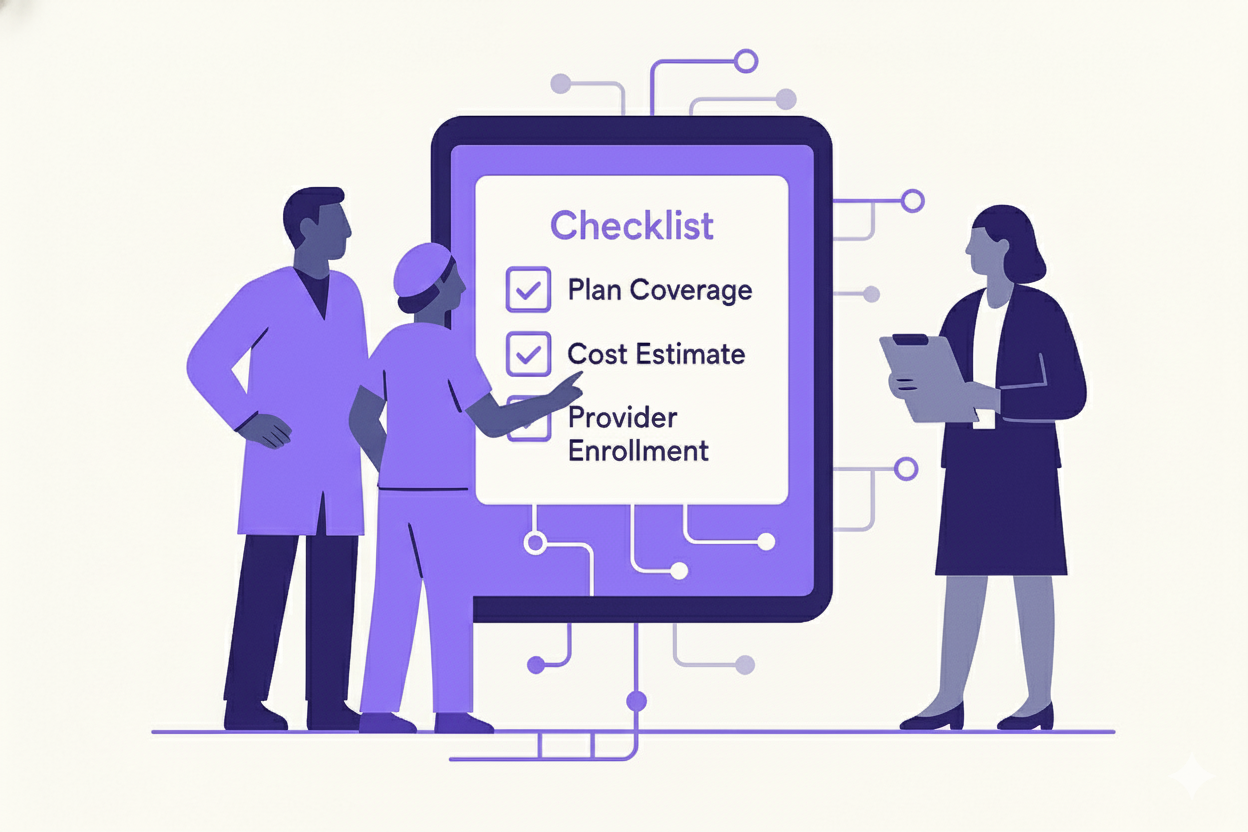
Eligibility is the hidden weak link in telehealth economics. Bridge’s three-pillar “surgical” model transforms it into an advantage—verifying coverage, calculating real costs, and guaranteeing payment with zero eligibility-related denials.
_optimized.avif)
Executive Summary
- Generic eligibility checks cause 15-20% claim denial rates in telehealth because they verify insurance coverage but not whether specific services are covered by specific policy types
- Bridge's "surgical" eligibility system uses three pillars—policy-level plan acceptance, contract-based cost calculation, and provider enrollment verification—to eliminate eligibility-related denials
- Precise, transparent eligibility increases patient conversion by 25-30% and enables Bridge to guarantee reimbursement, absorbing the risk when claims are denied due to eligibility failures
In 2009, surgeon and author Atul Gawande popularized a simple idea that would save thousands of lives: the surgical checklist. Before its widespread adoption, preventable errors in operating rooms were alarmingly common. Patients received incorrect anesthesia doses because allergies and weight weren't verbally confirmed before administration. Surgeons operated on the wrong limb because no one confirmed the surgical site. The procedures weren't complex—the problem was that critical steps were skipped or assumed.
The surgical checklist changed everything. By forcing teams to verify basics before every procedure, hospitals saw dramatic reductions in complications and deaths. The insight wasn't that surgeons needed to work harder. It was that they needed to be more surgical about the basics.
Telehealth has its own surgical checklist problem, but it's invisible until it's too late. It happens at patient eligibility—the moment when a telehealth company verifies insurance coverage before a visit. Get it wrong, and the downstream consequences cascade: denied claims, unexpected patient bills, lost revenue, and conversion rates that crater when patients can't trust what they'll owe.
Industry reports show denial rates of 20+% for telehealth providers, with digital health clinics experiencing bad debt as high as 20-40%. The root cause? Most telehealth companies are using generic eligibility checks that weren't designed for the specific services they deliver. Like a surgeon skipping the checklist, they're moving forward with incomplete information—and paying for it later.
The hidden cost of inaccurate eligibility
Walk into most brick-and-mortar medical practices, and the eligibility check follows a familiar ritual. The front desk scans your insurance card, runs it through their practice management system or EMR, and gets a response: active policy, general deductible information, maybe a copay amount. Then they tell you they can't say what you'll actually owe—you'll find out when the bill comes.
This opacity is surgical malpractice for telehealth and why patients dread healthcare costs. Even for a routine primary care visit, the answer to "what will this cost me?" is almost always "we don't know." The standard eligibility infrastructure isn't designed to provide transparency—it's designed to confirm that someone will eventually pay, whether that's the insurance company or the patient via surprise bill.
Traditional eligibility infrastructure—whether it's baked into EMRs, provided by clearinghouses, or offered through billing platforms—is built on the 271 EDI response format. This industry-standard system confirms active coverage and provides general cost-sharing information. What it doesn't do is tell you whether the specific service you're about to deliver is covered. It can't tell you how many medical nutrition therapy sessions the patient's plan actually covers. And it doesn't track whether your providers are enrolled with that specific payer or whether their enrollment is actually active yet.
For traditional healthcare, this limitation is manageable. But telehealth operates differently. Remote patient monitoring, chronic care management, behavioral health visits—these services use highly specific CPT codes that require targeted eligibility verification. A generic "yes, they have insurance" isn't enough when you need to know "yes, their insurance covers this exact service, delivered by this specific provider, in this state."
The result? Claims denied weeks later. Patients receiving unexpected bills. Conversion rates plummeting because patients can't get straight answers about costs. Revenue tied up in collections.
Why telehealth is different
Telehealth doesn't just use different technology than traditional healthcare—it operates under fundamentally different constraints that make precision eligibility critical.
First, there's the specificity of the services themselves. A telehealth platform focused on cardiometabolic care isn't delivering generic "office visits." They're delivering services via telehealth—and not all insurance plans cover telehealth the same way, or at all. Some plans have full telehealth parity, others limit it to specific service types, and some still exclude it entirely. Generic eligibility checks can't distinguish between these scenarios. Bridge's system verifies whether the patient's specific plan covers telehealth benefits for the services you're delivering—not just whether they have insurance.
Second, there's the state-by-state licensing complexity. Telehealth providers must be licensed in the state where the patient is located during the visit. But licensure alone isn't enough—the provider must also be enrolled with the patient's specific insurance plan. And even enrollment isn't enough if the effective date hasn't passed yet. A provider might be fully licensed and enrolled, but if their enrollment doesn't become active until next month, any claims submitted now will be denied.
Third, there are the limitations of the data infrastructure itself. The 271 EDI standard contains the raw data, but knowing where to look and how to interpret it requires deep expertise. Generic eligibility systems take the surface-level response at face value. They miss employer-specific carve-outs, custom benefit designs that modify standard plan coverage, and the nuanced details that determine whether a particular service is actually covered.
Each of these gaps creates a potential failure point. And when you're building a telehealth business at scale, these failures don't just happen occasionally—they compound with every visit scheduled.
The three pillars of “surgical” eligibility
Building eligibility infrastructure that works for telehealth requires rethinking the entire approach. At Bridge, we've architected our eligibility system around three core components, each designed to answer a specific question with surgical precision.
Pillar 1: plan acceptance with policy-level precision
The standard approach: Generic eligibility checks verify that a patient has an active insurance policy. They might confirm which carrier administers the plan—Aetna, United, Cigna—and provide high-level coverage information.
Why it fails for telehealth: Having an active policy isn't the same as having coverage for your specific service. A patient might have an active United plan, but is it a United plan that covers a specific telehealth service? Is it one of the dozens of regional United plans with different coverage rules? The standard approach treats "you have insurance" as the answer, when the real question is "does your specific policy type cover this specific service?"
Bridge's surgical approach: We've built a system that indexes over 6,000 distinct plan names and validates coverage at the policy type level. When a patient enters their insurance information, we don't just confirm active coverage—we verify that their specific policy includes the services you deliver. No dropdown menus forcing patients to guess whether their "Oxford Freedom Plan" is administered by United. No generic "you're covered" messages that turn into denied claims later.
For major carriers like UnitedHealthcare and Aetna, we've eliminated an even bigger friction point: we can run eligibility checks without requiring a member ID. Patients don't need to hunt for their insurance card or type in a long number—they can verify coverage and see their costs with just basic information. This single improvement has driven conversion increases of over 20% for our partners.
Real-world impact: This level of precision prevents the most common source of claim denials: submitting claims to plans that don't actually cover the service rendered. It also dramatically improves the patient experience—no one has to hunt for their insurance card or guess which carrier actually manages their coverage.
Pillar 2: accurate cost calculation using contract-level logic
The standard approach: Generic eligibility checks might return a patient's general deductible, coinsurance percentage, or copay amount. This information comes from the 271 response and represents what the patient typically owes across all medical services.
Why it fails for telehealth: General cost-sharing doesn't tell you what the patient will actually owe for your service. If a patient has 20% coinsurance, you need to know: 20% of what? The answer depends on your contracted rate with that specific payer, which generic eligibility systems don't have access to. Even if you know the percentage, you can't give the patient an accurate estimate without knowing your allowable amount.
Bridge's surgical approach: We maintain contract-level rate information across our entire payer network. When we run an eligibility check, we don't just return the patient's coinsurance percentage—we calculate their actual out-of-pocket cost based on your negotiated rates. If they have a $30 copay for telehealth visits, they see $30. If they have 20% coinsurance on a $150 allowable amount, they see $30, not a vague "you'll owe approximately 20%."
Real-world impact: Transparent, accurate pricing is one of the most powerful conversion tools in healthcare. When patients know their exact financial responsibility upfront, they complete bookings. When eligibility checks return vague cost ranges or generic coinsurance percentages, patients abandon the scheduling flow to "check with their insurance"—and many never come back. Surgical cost calculation turns uncertainty into confidence, and confidence drives conversion.
Pillar 3: provider matching with enrollment verification
The standard approach: Most eligibility systems completely ignore the provider side of the equation. They verify patient coverage and stop there, assuming that if the patient is covered, any licensed provider can deliver the service.
And EMRs aren't built to solve this problem either—they don't track provider enrollment status, effective dates, or payer-specific credentialing across multiple states. Most telehealth teams end up building and maintaining their own spreadsheets or databases to track which providers are enrolled with which payers, manually updating the information as enrollments are processed. It's incredibly manual, rarely real-time, and every day the data is out of date represents missed capacity and lost visits.
Why it fails for telehealth: Having a licensed provider isn't enough. The provider must be enrolled with the patient's specific insurance plan—and that enrollment must be active. A provider might be fully credentialed with Aetna, but if their enrollment effective date is two weeks away, any claims submitted before that date will be denied. This is especially complex in telehealth, where providers may be enrolled with dozens of different payers across multiple states, each with different effective dates and ongoing enrollment requirements.
Real-world impact: Provider enrollment failures are among the most frustrating denials because they're entirely preventable—and they completely undermine patient trust. Imagine being told your visit is covered, completing the appointment, and then learning weeks later that the claim was denied because your provider's enrollment wasn't active yet. From the patient's perspective, they did everything right. From the business perspective, you've now written off the revenue and damaged the relationship. Surgical provider matching prevents this by only surfacing providers who are not just licensed and enrolled, but actively eligible to see that specific patient on that specific date.
More precision, more patients
When patients can see that they're covered, know exactly what they'll owe, and book immediately without uploading insurance cards or entering member IDs—the experience shifts from friction to flow.
Consider the difference: Generic eligibility says "coverage found" and "you may owe a copay or coinsurance" without specifics. Surgical eligibility confirms coverage for the specific service and displays the exact out-of-pocket cost: $0, or $25, or $50—not a range, a number. Available providers who are licensed, enrolled, and active appear instantly.
The conversion lift is substantial. We’ve seen that simply accepting insurance improves conversion by 3-5x compared to cash-only models—but that's just the beginning. Layering in transparent, accurate eligibility checks drives an additional ~20% improvement in conversion, turning "we accept your insurance" into "here's exactly what you'll owe: $30." When patients trust the price they see, post-visit billing surprises drop, collections becomes simpler, and customer satisfaction improves.
More precision, more dependable revenue
The surgical checklist worked because it made the invisible visible. It forced teams to verify what they thought they knew. Surgical eligibility does the same thing for telehealth—it replaces assumptions with verification, generic checks with specific logic, and hope with confidence.
At Bridge, we're so confident in our surgical approach to eligibility that we take on the reimbursement risk ourselves. When we tell you a patient is covered, we guarantee it. If a claim gets denied due to eligibility failure, we cover it. That's not bravado—it's the natural outcome of building a system that checks every box on the list.
Because in healthcare, like in surgery, the difference between good enough and surgical precision is often the difference between success and failure. And for telehealth companies building sustainable, scalable businesses, getting eligibility surgically right isn't optional—it's foundational.
Ready to eliminate eligibility risk from your telehealth operations? Talk with the Bridge team.