Blog
The Internet Scales Great Care and Bad Care Equally
The internet amplifies both exceptional care and bad actors. In virtual care, clearly defined scope of practice is what separates the two. This post explains why scope clarity matters, how Bridge evaluates it before claims are filed, and why it’s foundational to scaling high-quality care nationwide.
.png)
Executive summary
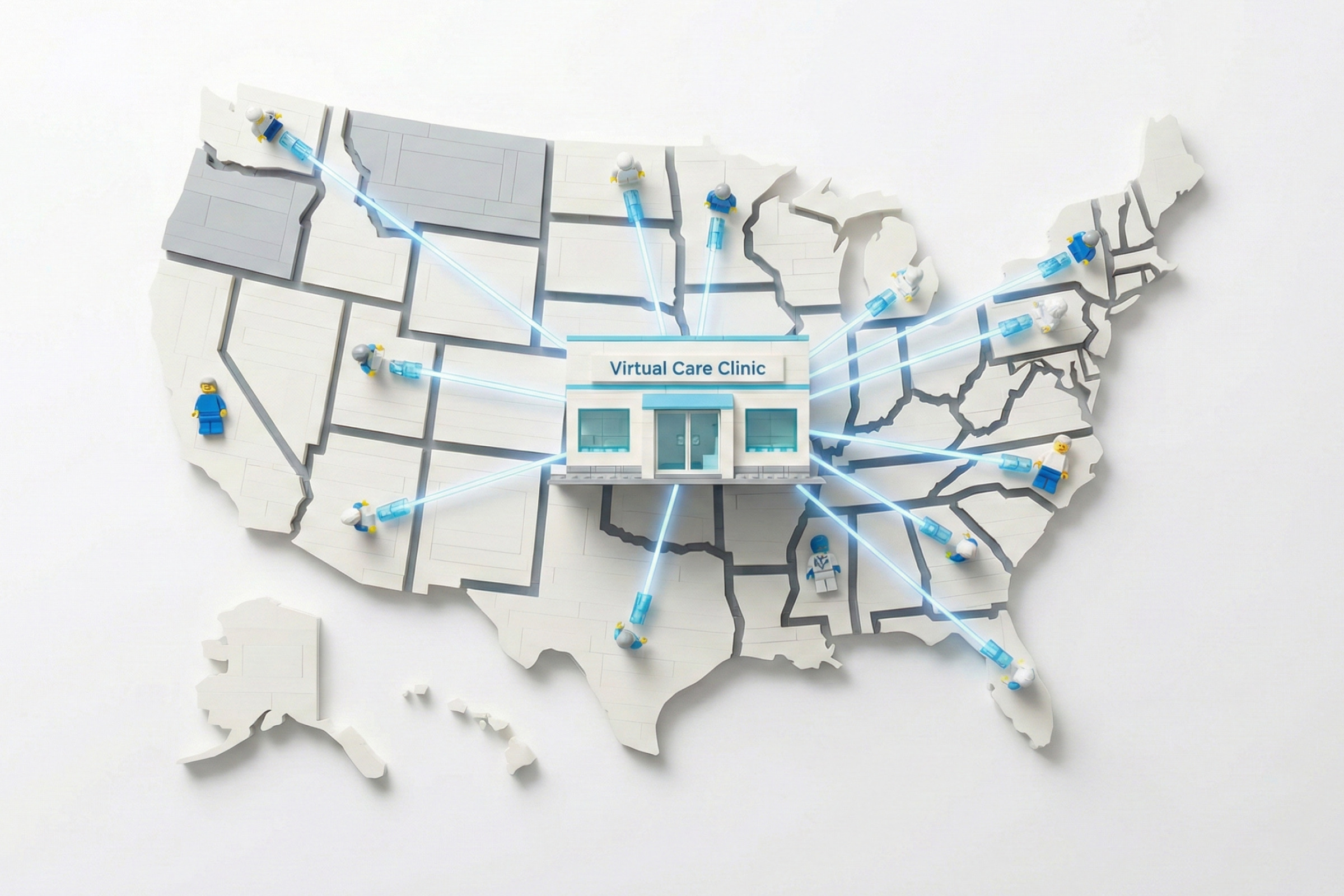
- Brick-and-mortar practices are naturally bounded by geography. Virtual care companies can attract massive patient volume around a targeted service from anywhere in the US, which means the same scale that powers great care models also enables bad actors. Scope of practice is what separates the two.
- Payers have limited visibility into what virtual care companies are actually doing between contract and audit. Bridge fills that gap by evaluating every partner's scope of practice before the first claim is filed, acting as a quality filter payers can't easily replicate on their own.
- The most mature virtual care companies operationalize scope into provider training, clinical decision-making frameworks, escalation protocols, billing workflows, and ongoing chart and billing audits, so that no individual provider is left making ad hoc decisions about what falls inside or outside the program.
A brick-and-mortar cardiology practice doesn't spend much time defining its scope of practice. It hangs a shingle, patients walk in with heart problems, and the payer relationship is straightforward. Everyone understands what the clinic does. Virtual care doesn't work that way. When a company can reach patients in all fifty states and attract massive volume around a targeted clinical service, the question of whether that program is delivering high-quality care for a real need or exploiting the internet's reach for something far less rigorous becomes both harder to answer and more important to get right.
This is one of the reasons Bridge exists. We serve as the billing and contracting infrastructure for virtual care companies, which means every program on our platform touches payer relationships we've spent years building. And one of the first things we learned is that the gap between what a virtual care company thinks it does and what a health plan can actually verify is enormous. Payers see claims. There's remarkably little context in a claim to tell you whether the care being delivered matches what everyone agreed to. Until an audit surfaces a problem or a complaint triggers a review, plans largely trust that a virtual care company stays within the boundaries of acceptable clinical practices.
Bridge fills that gap. We've built scope definition into the foundation of how we evaluate and onboard every partner, because our ability to maintain trust with payers and the financial commitments we make to our partners both depend on knowing exactly what each program delivers, what it doesn't, and where the boundaries are.
What scope clarity actually means
Scope definition, done well, is the operational blueprint of a clinical program. It's the documented answers to four questions that collectively determine whether a virtual care company is ready for a payer relationship.
The first is the most obvious. What clinical services does the program deliver, and what does it explicitly exclude? This goes well beyond listing diagnosis and CPT codes. A behavioral health program that treats anxiety and depression is making a very different commitment than one that also manages ADHD with controlled substances. Both may be clinically sound, but they represent fundamentally different utilization profiles, and the scope must be stated clearly enough for the payer, the provider, and Bridge to evaluate what's actually being underwritten.
The second question is who delivers the care, and where do responsibilities hand off? Understanding whether a program relies on physicians, nurse practitioners, licensed counselors, or some combination matters enormously for billing integrity, particularly when supervision models vary across states. When provider roles are left undefined, billing drift follows naturally.
Third, what place of service (ie. care settings) are included? A virtual-only program, a hybrid model with in-person components, and an asynchronous care management platform each carry different care policies and coverage patterns. Plans have different coverage policies for different place of service and modality.. Clinics, in turn, need to understand which modalities are actually reimbursable before building their care model around them.
And finally, how does the program handle situations that fall outside its defined scope? This is the question most companies skip entirely. When a patient presents with a need the program wasn't designed to address, the response should be governed by a documented referral pathway, not an ad hoc clinical decision. This happens more often than most people realize in virtual care, especially with providers who are used to the flexibility of brick-and-mortar practice. In a physical clinic, if a patient at a women's health practice presents with a thyroid issue, a nurse practitioner can walk down the hall, get buy-in from a collaborating physician, and manage the situation without anyone thinking twice. In virtual care, that hallway doesn't exist. If thyroid care isn't part of the program's documented scope and the provider is practicing in a state with strict supervision requirements, what felt like reasonable clinical judgment becomes a licensure and compliance problem. A provider freelancing on out-of-scope care is how everyone ends up in a difficult position.
At Bridge, we require every partner to work through these questions before going live on our platform. Our clinical quality team collaborates directly with each company to articulate their scope of practice, because the financial stakes are real. When a clinic delivers care within the scope we've agreed to and a payer claws back payment on a valid, in-scope service, Bridge absorbs that risk. When a clinic delivers services outside the agreed scope, we won't cover those visits. That mutual accountability drives Bridge's clean claims rate of 90%+, and it only functions when scope is defined with precision from day one.
Why this matters more in virtual care
As we explored in Inside the Mind of a Health Plan, health plans operate on fixed premiums collected upfront, which means they're essentially betting that the cost of care won't exceed what they've collected. Scope clarity is how a virtual care company strengthens that bet. It gives the plan enough definition to model costs, set appropriate reimbursement, and explain to employer clients exactly what they're getting.
Virtual care is structurally different from brick-and-mortar practice in a way that makes scope far more consequential. A traditional neurology clinic serves a neighborhood. The patients who walk through its doors have all kinds of neurological needs, the volume is naturally bounded by geography, and the practice treats whatever comes in. A virtual neurology company can do something a brick-and-mortar clinic never could. It can target a single condition, say migraines, and attract patients dealing with that exact problem from anywhere in the United States. The internet is extraordinarily good at connecting specific patient populations to specific services at massive scale.
That precision is what makes the best virtual care companies so effective. A tightly scoped migraine program can build protocols, train providers, and optimize outcomes around one condition in a way that a general neurology practice serving a local community simply can't. But the same dynamics that enable a beautifully designed, targeted care model also enable the opposite. A virtual care company practicing questionable medicine can just as easily attract drug-seeking patients from all fifty states and deliver shady care at volume that no brick-and-mortar practice could ever reach. The scale is the same. The only difference is what's being delivered and whether anyone is evaluating it before the claims start flowing.
This is the quality filter that Bridge provides and that health plans, by the nature of their vantage point, can't easily replicate on their own. We see the care model before claims are ever filed, and compare to regulatory and payer policies. We evaluate whether the services a company wants to deliver are actually covered, whether the billing codes match the clinical reality, and whether the program is structured to stay within bounds at scale. For payers, that evaluation means the companies coming through Bridge have already been vetted in ways that traditional credentialing and contracting processes don't capture. For clinic operators, it means the hard work of defining scope up front prevents the far harder work of responding to audits and repairing payer relationships after the fact.
Furthermore, as regulatory agencies and health plans update their policies, Bridge can push those changes upon notice of the updates. This ensures that our partners continue to deliver and receive payment for the best care.
The foundation
What separates the most mature virtual care companies is that they operationalize their scope into clinical policies that govern day-to-day care delivery. The scope lives in provider training, in clinical decision-making frameworks, in escalation protocols, in billing workflows, and in ongoing chart and billing audits. Every provider in the program knows what falls within their remit and what to do when a situation falls outside it, because those pathways have been defined and reinforced at every level of the operation.
This is the work Bridge does with every partner clinic. We deploy a standardized suite of clinical policies covering virtual visit conduct, emergency escalation, AI integration, and more, so that scope is never left to individual interpretation. The result is a system where financial risk, clinical quality, and payer trust are all aligned around the same set of clearly defined boundaries, and where the companies that do the work to define their scope precisely are the ones that scale predictably.